Why Grassroots Carbon Is Committing to 40 Million Acres of U.S. Grazing Lands by 2030 at Climate Week NYC
By Brad Tipper, CEO of Grassroots Carbon
Grassroots Carbon started in 2021 with a simple thesis: that environmental markets could create a new top-line revenue stream for America’s ranching families to help them invest in the productivity and resilience of their land and cattle operations. The thesis was unproven, but our conviction behind it was not. We believed there was enormous untapped value in America’s grazing lands, and that realizing it would begin with earning the trust of the ranching families who managed them. That trust would have to be earned ranch by ranch, by showing up, doing what we said we would do, and building a model that worked for the rancher first.
We started with 10 ranching families in Texas. We call them the Texas 10, and I will forever be grateful for the trust they placed in us. They believed, alongside us, that regenerative grazing practices could improve their operations while generating high-integrity environmental outcomes that companies would value and pay for. Five years later, those 10 families have grown to hundreds of ranching families across 3 million acres in 22 states.
Today, at Climate Week in New York, we are announcing the next chapter of that ambition. By 2030, Grassroots Carbon intends to support improved grazing management across 40 million acres of U.S. grazing lands, helping ranching families build more productive, profitable, and resilient operations for generations to come. As part of our participation in One Billion Acres, the impact campaign for Groundswell, at least 10 million of those acres will be fully verified through recognized pathways.
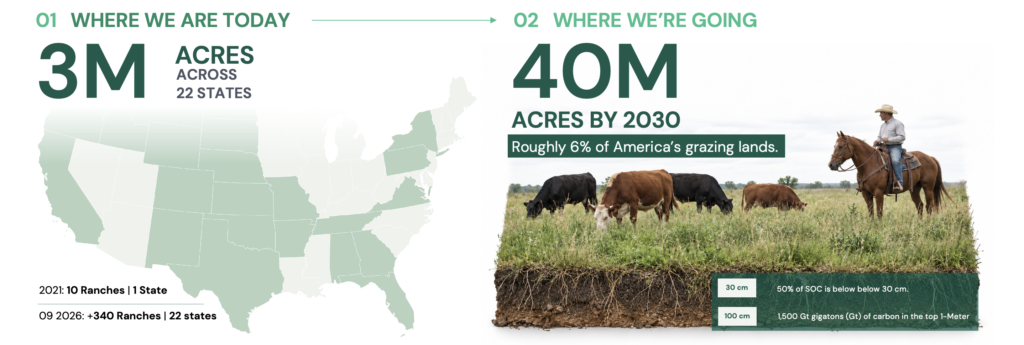
10 million verified acres is itself an enormous commitment. It represents more than three times the acreage we work across today, and we expect our partners, ranchers, and peers to hold us accountable for delivering it. But I also want to be clear that 10 million acres does not represent the full extent of our ambition. Our ambition is 40 million acres, or roughly 6% of America’s grazing lands.
The reason we care about 40 million acres, however, is not the number itself. It is what can happen on those acres. Better grazing management can mean more grass, more grazing days, healthier soils and more productive land. It can help ranchers reduce certain input costs and create new top-line revenue streams from environmental outcomes. Over time, it can help build operations that are more financially and ecologically resilient through drought, heat, wildfire, erosion and the other challenges inherent in managing working lands.
It is also important to be precise about what Grassroots Carbon does. We do not certify an acre, a ranch, an animal, or a product as “regenerative.” We work alongside ranchers implementing improved grazing management to measure and deliver environmental outcomes. Today, we deliver verified increases in soil organic carbon through atmospheric carbon drawdown, as well as greenhouse gas emission reductions from changes in management and inputs like nitrogen fertilizer. We are also actively developing programs to quantify water impacts, including volumetric water benefits, and biodiversity gains, such as improvements in habitat and grassland bird populations.
We’re not trying to turn ranches into carbon projects. We’re trying to help ranching families build better businesses on healthier, more productive land.
This distinction is important because Grassroots Carbon is not trying to turn ranches into carbon projects. A ranch is first and foremost a business, a livelihood and, very often, a multigenerational family operation. If we are successful, the ultimate measure of this work will not simply be how many tons of carbon we generate or how many environmental outcomes we deliver. It will be whether the ranching families we work with are operating better businesses on healthier and more productive land.
At Grassroots Carbon, we talk often about moving at the speed of trust. It is a principle I believe in deeply because we operate in a market where trust has been earned slowly and lost quickly. Companies should be accountable for the environmental claims they make. Outcomes should be measured and independently verified. Ranchers deserve to know that when someone claims to represent their work, they are doing so accurately. Standards, protocols and registries all play an essential role in protecting against greenwashing and giving buyers confidence that the outcomes they purchase are real.
After spending the past several years working alongside hundreds of ranching families across America, however, I have become convinced that some of the systems designed to protect that trust are not moving quickly enough. In our effort to build rigor, we have created processes that can take years to recognize changes already happening on the land. The land will not wait, and neither will a ranching family deciding whether it can afford another water line, another fence, or another year of changing how it manages its operation. Holding ourselves to a high standard should not require us to accept a pace that makes meaningful change more difficult to finance.
That tension is part of why the distinction between 10 million verified acres and our broader 40-million-acre ambition matters. The challenge is not to lower the standard so more acres can count. Without credible evidence, the regenerative movement leaves itself vulnerable to vague claims and greenwashing. Nor should our objective simply be to attach a “regenerative” label to more acres. What matters is what is actually changing in the management of the land, whether those changes are improving the ranching operation, and whether the resulting environmental outcomes can be credibly measured. The challenge is to develop credible pathways that allow ranchers to begin a transition today, attract the capital and support required to sustain it, and build the evidence necessary to verify outcomes over time. We should not have to choose between rigor and scale.
Earlier this year, I was reminded of the importance of this work while attending CERAWeek in Houston, a gathering dominated by conversations about energy, infrastructure and the extraordinary demands being created by artificial intelligence and hyperscale data centers. More than once, I heard cattle invoked as a convenient comparison: look at the water required to produce a hamburger, look at the emissions associated with cows, and then consider how much less significant another use of resources might appear by comparison.
We should not have to choose between rigor and scale.
I do not share that story to criticize the technology industry. Grassroots Carbon works closely with technology companies, and we are increasingly involved in conversations about the challenges and opportunities associated with data centers. I share it because the comparison reveals how deeply a simplified narrative has taken hold. A cow has become shorthand for emissions, while ranching has become shorthand for environmental harm. That framing leaves out the most important variable: management.
A cow is not a management practice. How cattle interact with the land depends on decisions made by the people managing them. When grazing is managed well, livestock can stimulate plant growth while adequate recovery periods can improve ground cover, cycle nutrients and encourage deeper root systems. Those changes can help soil absorb and retain more water and, under the right conditions, store additional carbon. The same animal on the same land can contribute to very different outcomes depending on when it moves, how long it stays and how much recovery the land receives.
I believe those of us working in regenerative agriculture have not done a good enough job helping the rest of the world understand that distinction. Ranching is still too often discussed as an environmental problem to be solved rather than an industry and community to be invested in. The regenerative movement speaks frequently about changing agriculture, but it cannot credibly transform America’s grazing lands without putting the ranchers who manage those lands at the center of the conversation. There is no viable path to regeneration at scale that does not include America’s ranchers and cattle producers.
A cow is not a management practice.
That is also why the scale of the opportunity matters. The USDA estimates that the United States has approximately 659 million acres of grassland pasture and range. Our 40-million-acre ambition represents roughly 6% of that landscape, which puts both the scale of our commitment and the opportunity still ahead of us into perspective. The One Billion Acres campaign can help turn that broader opportunity into visible, accountable progress while directing greater investment toward the farmers and ranchers doing the work on the land.
Ranchers need credible ways to demonstrate the changes they are making, and companies need credible evidence of those changes if we expect them to invest at the scale America’s grazing lands require. At the same time, we should be careful about what gets lost when everything happening on a ranch is translated into the metrics companies know how to measure.
For much of Grassroots Carbon’s history, the work of our ranching partners has ultimately been translated into a number. A measured and verified greenhouse-gas reduction or soil-carbon removal is delivered to a corporate customer and may eventually appear in a sustainability report. I am proud of those numbers. Grassroots Carbon physically samples soil to a depth of one meter rather than relying exclusively on modeled or practice-based estimates. We document changes in grazing management and measure what is happening on the land. That rigor matters, and the resulting outcomes have created real economic value for ranching families. As our work expands beyond carbon into water, biodiversity and other environmental outcomes, that same principle should remain: measure what is happening on the land, maintain the integrity of the outcome, and return economic value to the people whose management created it.
But something important gets lost when a ranch becomes a metric. Behind every measured outcome is a family making decisions about when cattle move, how long a pasture rests, where water and fencing should go, how much forage is available, and whether the ranch can support more cattle next year than it did this year. That family may divide larger pastures into smaller paddocks, extend recovery periods, rotate cattle more frequently or consolidate herds. They may change practices passed down through generations and invest significant time and money without any guarantee that the transition will be easy.
Those families take that risk because they believe they can leave the land in better condition while building a more productive, profitable and resilient ranch. Years later, some portion of their work may emerge as a line item measured in tons of carbon dioxide equivalent. Those outcomes matter, but they are evidence of a much larger story unfolding on the land. We need to connect the corporate outcome back to the acre, the ranch and the family that created it, because that is where the work actually happened.
The limitations of today’s systems should not define what we believe is possible tomorrow.
When we partnered with the Texas 10 in 2021, there were plenty of reasons to believe what we were trying to build would not scale. Five years later, we work with 340 ranching families across 22 states and approximately 3 million acres. There will be people who look at our commitment today and question whether we can go from 3 million acres to 40 million by 2030. They may be right. But the limitations of today’s systems should not define what we believe is possible tomorrow.
Getting there will require more than Grassroots Carbon. It will require standards and measurement systems that protect integrity while being capable of operating at much greater scale, and corporate partners willing to make long-term investments alongside American ranching families. Companies such as Nestlé and others that have invested alongside us have demonstrated what that partnership can look like, and my hope is that many more will follow.
There are hundreds of millions of acres of grazing land in this country and generations of ranching knowledge represented by the families who manage it. Connecting that extraordinary resource with long-term corporate demand and credible environmental measurement can create something far more consequential than a carbon market: an enduring source of economic value for rural America that helps ranching families build more productive, profitable, and resilient operations for generations to come.